Cognitive PPE:
Train the Mind
Behind the Work.
Attentional failure precedes incident. DropIT is an operational focus training protocol — grounded in human factors research — that builds the cognitive reset reflex before it's needed. On a rig, a floor, a dock, a line, or behind a counter.
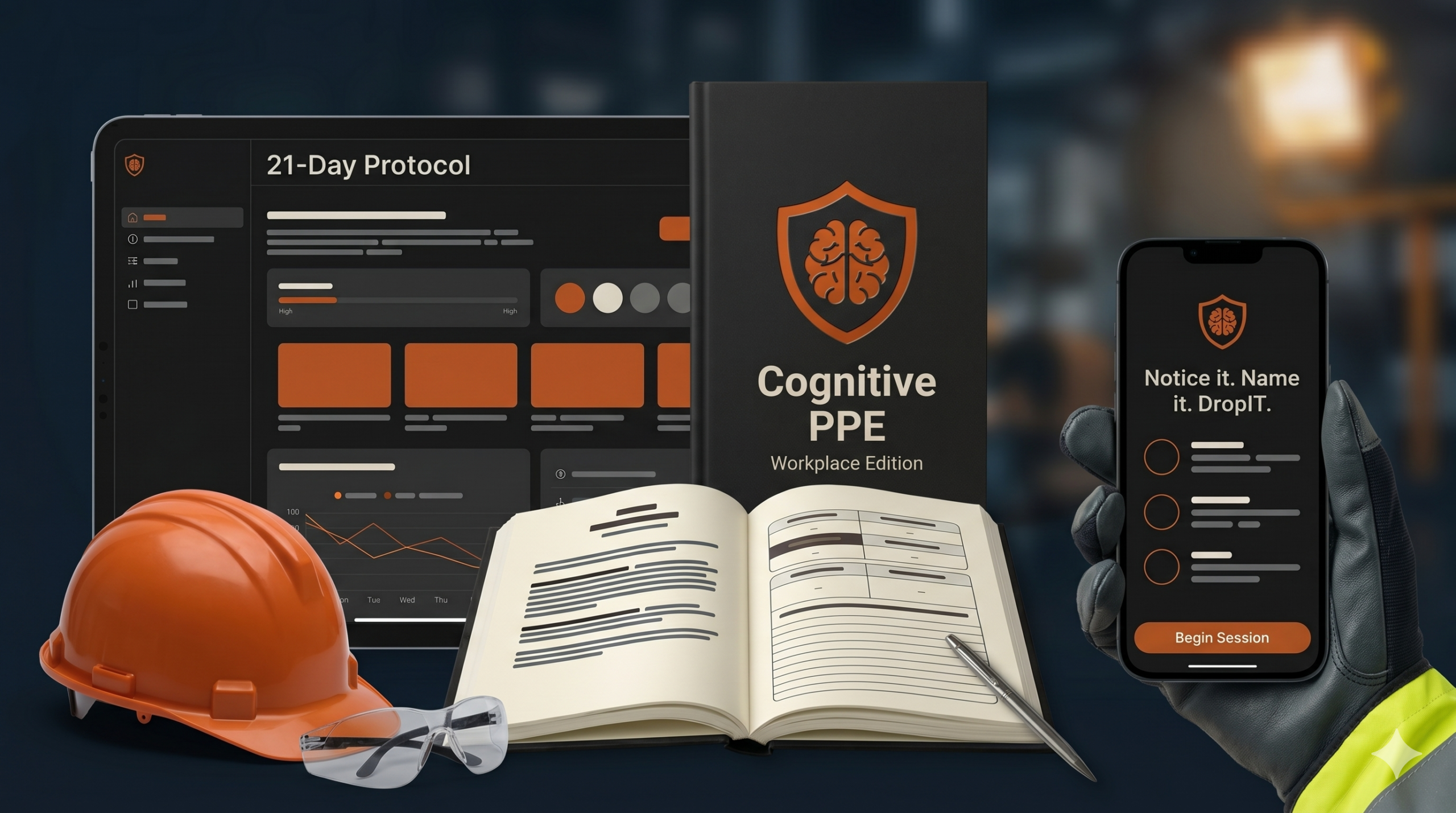
The hazard no PPE can reach.
When a worker's attentional resources are consumed by non-task cognition, hazard recognition is impaired — regardless of training, signage or the PPE they're wearing.

What's illustrated above is the problem. Here's what's actually in your hands.
Not a worksheet, and not a biometric sensor. A scored exercise the worker runs themselves, with a real number at the end of it.
The 60-Second Session
Count the drops, catch the thought that pulls you off the count. One scored rep a day, plus unlimited unscored Quick Practice — pre-shift, pre-task, after a near-miss.
Anchor-Accuracy Scoring
A measured number, not a self-rating. Every session scores how close the count was, what got caught, and what got past — attentional drift you can actually see.
On-Site Transfer Tracking
One tap after each session: did you use this on the job today? That number matters more than the score — a rising score with flat transfer means the exercise improved, not the shift.
Participation Record
A one-page export of completion, measured accuracy change, and transfer rate — for a training file or a safety meeting. No journal content, no recorded thoughts. Worker-controlled.
✓ Instant access · 30-day money-back guarantee
The Thought Triad — Three Attentional Gates
Every thought entering a worker's mind passes through three cognitive gates. Attentional failure occurs when one gate is unmanaged.
Notice → Name → DropIT
A repeatable three-step cognitive protocol. Deployable mid-task, pre-entry, or mid-shift. No screen. No setup. No interruption to the physical task.
Notice
Identify the intrusive thought as a non-task cognition. Awareness without engagement — the first gate of attentional control.
Name
Categorise silently: "Deadline." "Conflict." "Home." Affect labelling reduces amygdala activation and frees working memory. (Lieberman et al., 2007)
DropIT
Release deliberately. Return attention to task. Supports the situational awareness required for safe task execution.
Mentally absent vs. cognitively present.
The difference isn't visible. It's measurable in reaction time, hazard recognition, and decision quality.
Built for work where attention has consequences.
Cognitive Load Failure looks different on a rig, in a warehouse aisle, on a line, or behind a counter. The mechanism — and the training — is the same.
Oil & Gas / Mining
- Zero tolerance for cognitive lag in H2S, confined space, pressure systems
- Mental lag measured in seconds — consequences are permanent
- Pre-task reset critical before all safety-critical operations
Construction
- Height work and lift operations require active Inlet management
- Flooded sensory gate during lift sequence = critical blindness risk
- Tool-box talk alone cannot close the attentional gap
Utilities & Power
- Live-line and switching work leaves no margin for a wandering mind
- Lone and remote work removes the second set of eyes that catches drift
- Isolation and lock-out sequences depend on uninterrupted attention
Transport & Heavy Haul
- Long hauls and monotony are textbook conditions for attentional drift
- Pre-trip and yard movements demand a deliberate reset, not autopilot
- Carried thoughts from home follow the operator into the cab
Manufacturing & Processing
- Repetitive environments breed Outlet failure — active hazards go unregistered
- Routine masking: familiarity reduces attentional engagement
- Reset training restores active situational awareness on routine tasks
Healthcare & Emergency Services
- Emotional residue from prior calls degrades decision capacity
- Inner management restores attentional readiness between interventions
- Decision fatigue is a cognitive load issue — not a motivation issue
Warehouse & Distribution
- Pedestrians and powered equipment share the same aisle all shift
- Pick rates and pace targets compete directly with hazard awareness
Food Service & Hospitality
- Heat, blades and wet floors, at speed, for the length of a service
- A difficult table or a rush follows the worker to the next task unless it's dropped
Retail & Customer-Facing
- Cutters, ladders and manual handling between constant interruption
- Customer conflict carries into the next hour of the shift
Office & Professional
- Here the cost is error and rework, not injury — but the mechanism is identical
- Deadline and hierarchy pressure compete directly with focused work
Grounded in human factors research.
The three-step protocol is not intuitive — it is neurologically grounded. Each step maps to established cognitive science.
Human factors cited as a contributing cause in up to 90% of workplace incidents — the figure HSE applies across industry.
HSE, Reducing Error and Influencing Behaviour (HSG48); HSE human-factors guidance, hse.gov.ukMind-wandering occupies approximately 47% of waking hours. When it occurs, self-reported unhappiness and task-performance degradation consistently follow.
Killingsworth & Gilbert, Science (2010) — 250,000 data points, 83 countriesAffect labelling — putting a feeling into words — measurably reduces amygdala activity and increases prefrontal regulation. This is the neurological basis of Step 2: Name it.
Lieberman et al., Psychological Science 18(5), 421–428 (2007)Sustained attentional capacity degrades within approximately 20 minutes of task onset under standard conditions — without deliberate reset.
Warm, Parasuraman & Matthews, Psychological Bulletin (2008)DropIT is an attentional training protocol informed by cognitive science research. It is not a clinical intervention and does not replace professional occupational health, EAP services, or site-specific safety management systems.
The protocol trains it. The method deploys it — no screen required.
One reflex per week. Week 1: Notice. Week 2: Name. Week 3: DropIT. By Day 21 the three steps run as a single automatic response.
No phone. No screen. No setup. Mid-task, pre-entry, mid-shift — the trained worker notices, names, and releases. Invisible. Immediate.
Everything you need to condition the reflex.
Operational attentional safety training for high-hazard and high-tempo workplaces. Not a wellness product — a human performance protocol.
Per seat · One-time purchase · Instant access · No subscription
Complete the 21 days. If you notice no difference in how your mind handles unwanted thoughts at work, reply to your order email for a full refund. No form. No process. Just a reply.
Implementing for a crew or organisation? Volume pricing available for 10+ seats.
Each seat is a private, individual account. Workers choose if and when to share their own summary — there's no manager view across a crew.
Request Crew Pricing